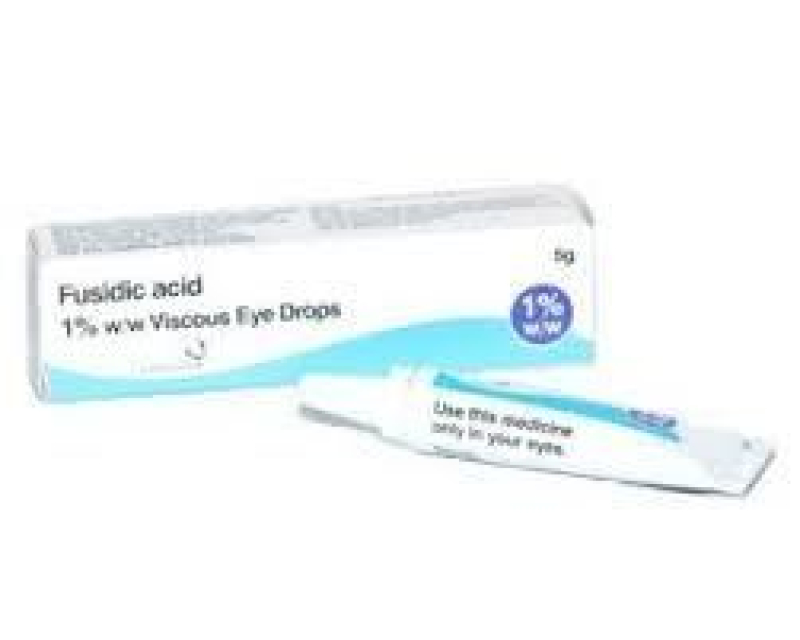
Fusidic acid eye drops are prescribed for eye infections caused by germs called staphylococcal bacteria. The drops kill the germs which are causing the infection.
Eye infections are a common cause of conjunctivitis. In conjunctivitis, your eye becomes inflamed, feels gritty, and may water more than usual. The white of your eye may look red, and your eyelids may become swollen and stuck together with a discharge when you wake up in the morning. Only one eye may be infected to begin with, but it often spreads to both eyes. Most cases of infective conjunctivitis clear within a week or so without treatment. For more severe infections, or for infections which do not clear on their own, an antibiotic eye drop such as fusidic acid is helpful.
Before you start the treatment, read the manufacturer's printed information leaflet from the pack. It will give you more information about the drops and will provide you with a full list of any side-effects which you may experience from using them. If your eyes have an obvious discharge or 'crust', it can help if you bathe them with cool clean water before using the drops.
Wash your hands before you use the drops.
Remove the cap from the tube.
Tilt your head back a little and gently pull the lower lid of your eye out to form a pocket.
Hold the tube upside down near to your eye. Try not to touch your eye as you do this.
Gently squeeze the tube to release one drop into the pocket created by your lower eyelid. Only use a second drop if the first drop missed going into your eye.
Close your eye for a minute or two, and press gently on the side of your nose where the corner of your eye meets your nose. This helps to stop the drop from draining away and keeps it in your eye.
Repeat the process in your other eye if you have been asked to use the drops in both eyes.
Replace the tube cap.
Before you start the treatment, read the manufacturer's printed information leaflet from the pack. It will give you more information about the drops and will provide you with a full list of any side-effects which you may experience from using them. If your eyes have an obvious discharge or 'crust', it can help if you bathe them with cool clean water before using the drops.
Wash your hands before you use the drops.
Remove the cap from the tube.
Tilt your head back a little and gently pull the lower lid of your eye out to form a pocket.
Hold the tube upside down near to your eye. Try not to touch your eye as you do this.
Gently squeeze the tube to release one drop into the pocket created by your lower eyelid. Only use a second drop if the first drop missed going into your eye.
Close your eye for a minute or two, and press gently on the side of your nose where the corner of your eye meets your nose. This helps to stop the drop from draining away and keeps it in your eye.
Repeat the process in your other eye if you have been asked to use the drops in both eyes.
Replace the tube cap.
Extended side effects of fusidic acid 1% eye drops
Local ocular effects
- Very common/mild: transient burning, stinging, itching, irritation, foreign?body sensation, transient blurred vision immediately after instillation.
- Conjunctival signs: hyperemia (redness), increased lacrimation/epiphora, conjunctival swelling.
- Eyelid/skin reactions: eyelid dermatitis, contact dermatitis, local eczema or rash around the eye.
- Corneal effects (rare): epithelial irritation, delayed corneal healing or worsening if used on corneal ulcers without specialist guidance.
- Secondary/superinfection: overgrowth of non?susceptible organisms (including fungi) with prolonged use.
Hypersensitivity and immune-mediated
- Allergic reactions: localized hypersensitivity (pruritus, swelling, erythema), and rarely more severe allergic responses such as angioedema. Discontinue if suspected.
- Type IV contact allergy may present after repeated exposure.
Serious ocular events (rare)
- Severe conjunctivitis or worsening inflammation, severe eye pain, pronounced vision changes — may indicate incorrect use, resistance, or an alternative/serious pathology (e.g., keratitis) requiring urgent review.
Systemic effects (very rare)
- Minimal systemic absorption with topical ocular use; systemic adverse effects are uncommon but theoretically possible (e.g., systemic allergic reaction) especially with extensive mucous membrane exposure or in neonates.
Resistance and long-term risks
- Development of bacterial resistance with inappropriate or prolonged use. Repeated prolonged courses may select for resistant strains and alter local flora.
Drug interactions and special populations
- No major systemic drug interactions expected due to low systemic absorption; caution if used concurrently with systemic fusidic acid (rare scenario) — consult clinician.
- Pregnancy/lactation: limited data; use only if clearly needed and after medical advice.
Warnings — Fusidic acid 1% eye drops
- Allergy: Do not use if known hypersensitivity to fusidic acid or any excipient. Discontinue and seek medical help for signs of allergic reaction (rash, swelling, severe redness, breathing difficulty).
- Contact lenses: Remove lenses before instillation; do not wear lenses during treatment unless advised by a clinician.
- Corneal disease/keratitis: Not recommended for suspected corneal ulcers or severe keratitis without ophthalmology review — may delay appropriate therapy.
- Severe symptoms: Seek urgent care for severe eye pain, sudden vision loss, marked photophobia, intense redness, or worsening symptoms.
- Concomitant steroids: Avoid unsupervised use with topical ocular steroids — steroids can worsen or mask infections.
- Prolonged use/resistance: Prolonged or inappropriate use may promote resistance or secondary infections (including fungal). Use for shortest effective duration.
- Neonates/pregnancy/breastfeeding: Limited safety data—use only if clearly needed and after medical advice.
- Contamination risk: Do not touch the dropper tip to any surface or the eye; discard if contaminated.
- Storage/expiry: Follow product label; do not use after expiry.
- Interactions: Minimal systemic interactions expected; avoid simultaneous systemic fusidic acid without medical advice.
If symptoms fail to improve within 48–72 hours or worsen, obtain medical/ophthalmology review.